Showing posts with label amputee. Show all posts

Wednesday, 12 February 2014

A bionic hand with the sense of touch

Aabo Dennis Sorensen, Danish 36, lost his left hand 10 years ago when a firecracker exploded during the celebration of New Year. He never expected to regain feeling or to feel something. But now he has recovered the sense of touch thanks to a bionic hand that allows him to catch and identify objects even blindfolded.

The prototype is connected to the nerves of Dennis' left arm and serves as a link between his body and the machine. Scientists from Italy, Switzerland, Germany, Britain and Denmark have participated in the project - developed at the Gemelli hospital in Rome and published today in the journal Science Translational Medicine' - and they are confident that this prosthesis will revolutionize the lives of many people with amputations.

In their daily life, Sorensen used a prosthesis that detects muscle movements and allows him to open and close the hand but it doesn't allow to have any sense of touch, so he needs to be careful not to break the stuff he tries to grab. The new prosthesis, named LifeHand 2 is more sophisticated as it combines intranervous connections, robotics and computer science to recreate the sense of touch.

Tomada de Lapatilla.com

The patient was implanted tiny electrodes with the thickness of a human hair in the ulnar and median nerves of the arm before putting the bionic hand, which is equipped with several artificial sensors. These sensors measure the strain on the tendons of each finger to find the force required to catch every object. Computer algorithms transform this information into electrical signals that the nerves can interpret.

The result is a feeling very near to real touch, including different intensities that have allowed Sorensen distinguish shapes and textures of different objects. In a series of experiments blindfolded, he can recognize the basic forms of a series of objects and notice the differences between and orange and a baseball. Scientists will now work to ensure that the hand is able to differentiate between more refined textures and between hot and cold and get the patient to live "several months" with the device.

"It was a great experience. It was amazing to feel something after feeling nothing for so many years ," said Sorensen. "I have been pretty close to the same feeling as if I had a normal hand", he assured.

The device is still experimental and it won't be available for a few years yet. Researchers still have work ahead to reduce components and the amount of cables which limit its current use to the lab. Nevertheless, it is a fantastic advancement of technology that surely someday many people will be enjoying around the world.

Wednesday, 21 November 2012

More for the feet

As I am one of the many runners out there that use insoles to correct defective positions while walking and running, I found this quite interesting.

At the University of Utah engineering professor Stacy Bamberg recently developed a smart insole that seems to resemble the high technology Nike shoes and other Nike products for running. In this case, it goes beyond that, as this insole could help patients with prosthetic legs and people in rehab to correct walking abnormalities after a fracture or hip replacement.

The device is called Rapid Rehab and consists of a personalized gel insole embedded with force sensors, accelerometers and gyroscopes to detect the way a person walks. Rapid Rehab also contains a wireless transmitter to send data from sensors to a custom application for your smartphone that tracks and provides immediate visual, audio or sensory feedback to the user. The current version specifically contains two force-sensitive resistors that track the pressure the foot exerts when it is on the ground, as well as an accelerometer and a gyroscope to measure foot position and angle.

Image: copyright U News Utah

At present, the insole Rapid Rehab is used by amputees who want to reduce the limp when using a prosthetic leg. However, Bamberg expects it to be also used by physiotherapists and their patients who have received a hip replacement or suffered a bone fracture and need to correct their gait, since Rapid Rehab has proven to be less expensive than a gait-analysis laboratory study, more accurate than subjective observations of a physiotherapist, and faster in providing feedback.

Source: http://unews.utah.edu/news_releases/utah-engineering-prof-invents-smart-insole-to-correct-walking-abnormalities/

Wednesday, 14 November 2012

A bionic foot made in Brussels


I had not written for a long time about one of my favorite topics: bionic limbs. Fortunately this morning I found an interesting story that also touched me in a particular way, since the engineers who have developed this idea live in my city, Brussels.

Indeed, research engineers at the Vrije Universiteit Brussel, have developed a new active transtibial prosthesis that mimics the natural movement of the ankle and using energy efficiently. Instead of using powerful engines which start and stop at every step, the system activates an electric motor continuously to continuous stretch a rubber band, which in turn is used by the foot as a source of motive power.

By reducing the total energy requirement of the prosthesis, you can use smaller batteries, reducing the overall weight of the device. Moreover, the smaller engines, quieter and more efficient can also simplify the design and implementation.

Check out the video, it's amazing how well it resembles the motion of an actual foot!


Monday, 7 May 2012

A mechanical hand controlled by thought

Reality overcomes fiction once more. Some years ago, a bionic arm was something we could only imagine in the Terminator or Star Wars movies. Remember the mechanical hand that Luke Skywalker had implanted after  Darth Vader cut his hand with his lightsaber? Well, nowadays thousands of people with amputees arms already benefit from a similar technology. 

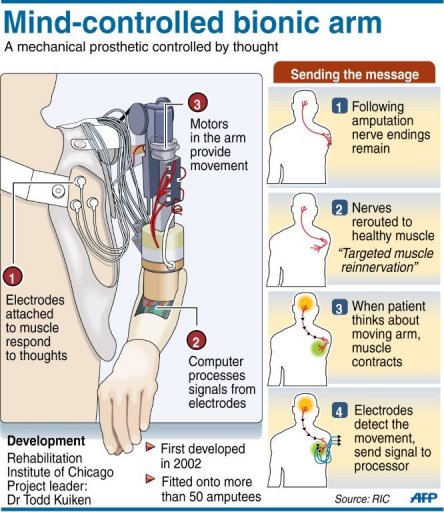
Initially patients could move the arm through redirected nerves that sent electrical signals to sensors placed on his chest. The first prototype was implanted to the American Jesse Sullivan in 2002. Jesse is an electrician and suffered a terrible accident in May 2001 as he touched a wire with a voltage close to 7,500 volts. The bionic arm that he had implanted cost around six million dollars. The second person who received one of these prostheses was the young Claudia Mitchell (27 years). The former Marine lost his left arm in a motorcycle accident and has been operating with its robotic limb since August 2006. Claudia can now put on shoes, wash or peel a banana. Furthermore, she had the sense of touch restored as she was able to feel things she touched with her artificial hand through a device attached to her chest. During a four-hour operation, surgeons moved nerves from her shoulder, which normally ferry signals from the hand to the brain, and redirected them to muscles in her chest area. Four months after surgery, a patch of skin on her chest was able to feel touch, temperature and pain sensations as if they were coming from different parts of her hand and wrist.


Last year, Dr. Todd Kuiken, director of bionic medicine center and director of amputees at the Rehabilitation Institute of Chicago (RIC) presented a new advancement, the Targeted Muscle Reinnervation (TMR). Kuiken and his team developed this innovative surgical procedure that routes signals from the brain to the nerves of the muscles that are healthy after an amputation, allowing patients to control their prosthesis just by thinking the action they want to perform. This was the world's first bionic arm controlled by nerves, which reflects the patient's brain impulses. (See image to learn a bit of how it works)


If you want to know more about bionic arms, I recommend you the Bionic Bodies series on the BBC News website: http://www.bbc.co.uk/news/health-17139965

Also, check out this video if you want to see how a young orthopaedic patient is getting used to a new bionic arm:


See you soon