Showing posts with label bionic arm. Show all posts

Tuesday, 5 March 2013

Rex, the bionic man

Technology is turning into reality many of the utopias of science fiction and shortens time between what writers imagine and what scientists can do. The latest example is Rex, the first fully bionic man, which apparently has much in common with Steve Austin, the artificial man who starred the seventies television series called The Man of The Six Million. 

The bionic man is being built from $1,000,000 of limbs and organs by leading UK roboticists Richard Walker and Matthew Godden. All his vital organs were built in a laboratory and it is considered to be the most complete bionic man achieved by science so far.


This bionic man, on display in the Science Museum in London, has also synthetic blood and robotic limbs. With a face that resembles humanity, Rex incorporates some of the latest advances in prosthetic technology: - A prosthetic foot and ankle developed by Massachusetts Institute of Technology professor Hugh Herr), - A SynCardia Systems artificial heart - A bionic ear from Macquaire University in Sydney - An eye made of a camera mounted in Rex's glasses and an artificial kideny from University of California - An artificial trachea, first received by a cancer sufferer in 2011, from Royal Free Hospital, London - A spleen from Yale, Connecticut. - An artificial pancreas from De Montfort University, Leicester One of the experts who participated in its construction, Richard Walker, told the BBC that the result of the work is "very significant", since it has allowed to know "how close are prosthetic technology to rebuild the whole human body." "There are some vital organs missing, like the stomach, but 60 to 70 percent of a human has effectively been rebuilt" said Walker. Bertolt Meyer, one of the creators of Rex who was born without a right hand and wears a bionic prosthesis, said that "the great promise of technology is that it can wipe out disabilities." 

However, technology developers claim that not all technology is useful for replacing body parts. For example, hands can not move without bionic human muscle and brain signals. “What we are beginning to achieve is building prostheses which look like human body parts, but we are a long way away from making ones which relay sensory information the way the human body does.” Once medical science improves, as it inevitably will, Meyer says the next step will be tackling the sticky ethical issues which will arise. “Should I be allowed to cut off my real hand and replace it with something, does that give me an unfair advantage over people who cannot afford this?” asks Meyer. “I’m not saying that is going to happen but these are questions that should be on the table before that technology becomes available.”. 

Tuesday, 18 December 2012

Neuroprosthetic controlled by thought


A woman, aged 52 and tetraplegic, has managed to control and manage a newly developed robotic hand with her thoughts only, U.S. scientists revealed in the journal The Lancet. Experts explained this advancement required a new form of transmission of nerve impulses that uses the natural control of muscles as a reference.

Jan had lost the ability to move her arms and legs more than 10 years ago due to a degenerative disease called spinocerebellar degeneration, which caused damage to his spinal cord similar to a fracture of the spinal column in a traffic accident. The team from the University of Pittsburgh, Pennsylvania (USA), directed by Andrew Schwartz, treated the patient before she was completely quadriplegic, although shortly after putting on the electrodes she could not longer move her arms. 

Scientists implanted her with two microelectrodes in the motor cortex of the brain. These were connected to a robotic arm with an artificial hand and fingers. Two days after the operation the woman could move the arm, from left to right, up and down, only through her thoughts. After 13 weeks of training, she could perform certain actions in order to take things and her movements became faster and more efficient, as scientists revealed.


The prosthetic arm, designed by the John Hopkins University's Applied Physics Laboratory. DARPA and JHU/APL​.

The innovative technique which makes use of the robotic arm is more intuitive for patients, because instead of having to think about where to move the arm, the patient simply has to focus on the goal, as one would do when trying to to score a basket. Although several groups around the world are developing similar prototypes, none has achieved these impressive results. Jan managed to move objects on a table, including cones, blocks and small balls, catching them and changing their location.

"We were impressed by how quickly she was able to acquire his skill. It was totally unexpected," said Andrew Schwartz, professor of neurobiology at the University of Pittsburgh and lead investigator of this project. "At the end of one day, when she was doing these beautiful movements, she was very excited."

To connect the woman to the robotic arm, doctors performed a four-hour operation to implant two tiny electrodes grids of 4 mm on either side of Jan's brain. Each grid has 96 tiny electrodes that protrude 1.5 mm . The electrodes were pushed just below the surface of the brain, near the neurons controlling the hand and arm movement in the motor cortex. Before Jan could use the arm, the doctors had to record her brain activity as she imagined various arm movements. For this, she was asked to look at the robotic arm and try to move it in the same way as she would do with her own arm.

What is yet to come

There are several challenges yet to solve. One is that the robot hand can send sensory impulses to people, so that they can interact with objects according to their texture and temperature.

A second objective is to develop thinner electrodes with a thickness of about five thousandths of a millimeter, to avoid problems like the one Jan has developed after the publication of the study. It is about a scar tissue that forms around the electrodes and that degrades the signals the brain sends to the computer. With smaller electrodes, the body may not trigger any healing process.

Another major focus of future work is to develop a wireless system, so that the patient does not have to be physically connected to the computer that controls the robot arm.

Monday, 7 May 2012

A mechanical hand controlled by thought

Reality overcomes fiction once more. Some years ago, a bionic arm was something we could only imagine in the Terminator or Star Wars movies. Remember the mechanical hand that Luke Skywalker had implanted after  Darth Vader cut his hand with his lightsaber? Well, nowadays thousands of people with amputees arms already benefit from a similar technology. 

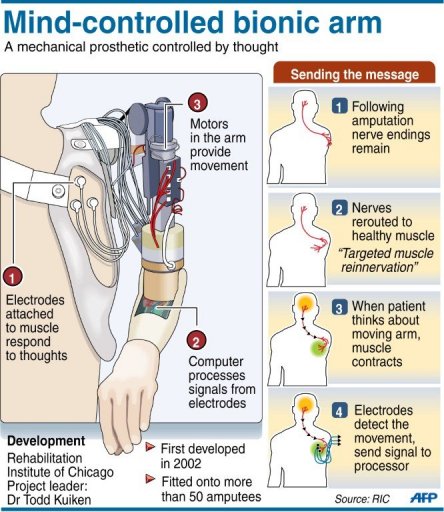
Initially patients could move the arm through redirected nerves that sent electrical signals to sensors placed on his chest. The first prototype was implanted to the American Jesse Sullivan in 2002. Jesse is an electrician and suffered a terrible accident in May 2001 as he touched a wire with a voltage close to 7,500 volts. The bionic arm that he had implanted cost around six million dollars. The second person who received one of these prostheses was the young Claudia Mitchell (27 years). The former Marine lost his left arm in a motorcycle accident and has been operating with its robotic limb since August 2006. Claudia can now put on shoes, wash or peel a banana. Furthermore, she had the sense of touch restored as she was able to feel things she touched with her artificial hand through a device attached to her chest. During a four-hour operation, surgeons moved nerves from her shoulder, which normally ferry signals from the hand to the brain, and redirected them to muscles in her chest area. Four months after surgery, a patch of skin on her chest was able to feel touch, temperature and pain sensations as if they were coming from different parts of her hand and wrist.


Last year, Dr. Todd Kuiken, director of bionic medicine center and director of amputees at the Rehabilitation Institute of Chicago (RIC) presented a new advancement, the Targeted Muscle Reinnervation (TMR). Kuiken and his team developed this innovative surgical procedure that routes signals from the brain to the nerves of the muscles that are healthy after an amputation, allowing patients to control their prosthesis just by thinking the action they want to perform. This was the world's first bionic arm controlled by nerves, which reflects the patient's brain impulses. (See image to learn a bit of how it works)


If you want to know more about bionic arms, I recommend you the Bionic Bodies series on the BBC News website: http://www.bbc.co.uk/news/health-17139965

Also, check out this video if you want to see how a young orthopaedic patient is getting used to a new bionic arm:


See you soon