Monday, 7 May 2012

A mechanical hand controlled by thought

Reality overcomes fiction once more. Some years ago, a bionic arm was something we could only imagine in the Terminator or Star Wars movies. Remember the mechanical hand that Luke Skywalker had implanted after  Darth Vader cut his hand with his lightsaber? Well, nowadays thousands of people with amputees arms already benefit from a similar technology. 

Initially patients could move the arm through redirected nerves that sent electrical signals to sensors placed on his chest. The first prototype was implanted to the American Jesse Sullivan in 2002. Jesse is an electrician and suffered a terrible accident in May 2001 as he touched a wire with a voltage close to 7,500 volts. The bionic arm that he had implanted cost around six million dollars. The second person who received one of these prostheses was the young Claudia Mitchell (27 years). The former Marine lost his left arm in a motorcycle accident and has been operating with its robotic limb since August 2006. Claudia can now put on shoes, wash or peel a banana. Furthermore, she had the sense of touch restored as she was able to feel things she touched with her artificial hand through a device attached to her chest. During a four-hour operation, surgeons moved nerves from her shoulder, which normally ferry signals from the hand to the brain, and redirected them to muscles in her chest area. Four months after surgery, a patch of skin on her chest was able to feel touch, temperature and pain sensations as if they were coming from different parts of her hand and wrist.


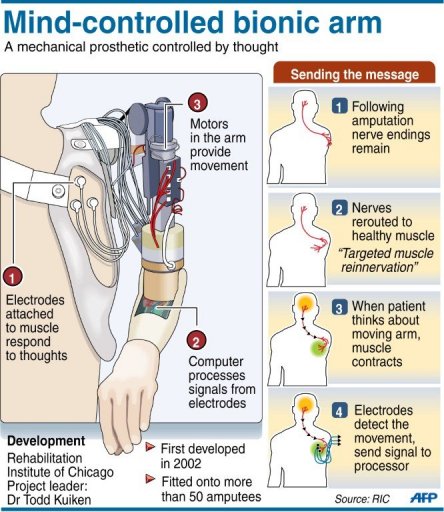
Last year, Dr. Todd Kuiken, director of bionic medicine center and director of amputees at the Rehabilitation Institute of Chicago (RIC) presented a new advancement, the Targeted Muscle Reinnervation (TMR). Kuiken and his team developed this innovative surgical procedure that routes signals from the brain to the nerves of the muscles that are healthy after an amputation, allowing patients to control their prosthesis just by thinking the action they want to perform. This was the world's first bionic arm controlled by nerves, which reflects the patient's brain impulses. (See image to learn a bit of how it works)


If you want to know more about bionic arms, I recommend you the Bionic Bodies series on the BBC News website: http://www.bbc.co.uk/news/health-17139965

Also, check out this video if you want to see how a young orthopaedic patient is getting used to a new bionic arm:


See you soon

Saturday, 7 April 2012

More on anticancer drug delivery using nanoparticles

I just came across an article in http://www.medicalnewstoday.com which goes over the use of  use of gold nanoparticles carrying drug molecules to target and treat cancer cells, something that was already presented in this post last February. This confirms that scientist keep foreseeing nanotechnology as new treatment against cancer, which might also replace radiation, chemotherapy, etc... in a near future.

In the study presented, the researchers used a single-stranded DNA aptamer called AS1411 which does two jobs. The first is to bind with the "shuttle" protein nucleolin, which is over-expressed in cancer cells and present inside the cell and on the cell surface. The second job is, once it is released from the nanostar, is to act as the drug itself. The results were quite more than satisfactory, as scientist observed death and decline in cancer cell population, exactly the intended objective.

You can find the whole article at this address: 
http://www.medicalnewstoday.com/articles/243856.php

See you in the next biomedipost :)

Tuesday, 3 April 2012

Never-before-seen implant

In my last post, I discussed about what we can expect from developments in cochlear implants, a technology that has been with us for more than 30 years. As it was briefly explained, cochlear implants stimulate the cochlea by means of electrodes, making possible for the brain to interpret this information as sound. In this way, I have been thinking if it wouldn't be possible to do the same for blind people. A quick search on google and... voila, I found that we already have what it is called "a retinal stimulator" or "artifical retina" implant.

Some history I found about it: In the mid-1980s, the neuroophthalmologist Joseph Rizzo III was researching retinal transplants to restore blind people's vision. One day, removing a lab animal's retina, a tissue-thin membrane that lines the back of the eyeball's interior, he made a tremendous discovery. "The moment I made the cut, I said to myself, 'What in the hell are you doing?'" Rizzo recounts. He realized he was cutting nerve connections that are actually spared in many forms of blindness. The retina's light-sensing cells (photoreceptors, or rods and cones) die off in retinitis pigmentosa and age-related macular degeneration, which affect millions worldwide; but the nearby neurons that ferry the signals from those cells to the brain remain intact.

Electrode implanted in the back of the eye (© Springer Science) 
So Rizzo conceived what he called "a retinal prosthesis", a device intended to bypass the damaged eye structure. This has evolved to what we call nowadays and artificial retine which works as follows: a miniature camera mounted in eyeglasses captures images and wirelessly sends the information to a microprocessor (worn on a belt) that converts the data to an electronic signal and transmits it to a receiver on the eye. The receiver sends the signals through a tiny, thin cable to the microelectrode array, stimulating it to emit pulses. The artificial retina device thus bypasses the damaged photoreceptor cells and transmits electrical signals directly to the retina’s remaining viable cells. The pulses travel to the optic nerve and, ultimately, to the brain, which perceives patterns of light and dark spots corresponding to the electrodes stimulated. Patients learn to interpret these visual patterns. A lot of research and effort has been put in this technology since then and finally last year the first such device was approved in Europe for commercialization: The Argus II Retinal Prosthesis System by Second Sight.

But this shouldn't be perceived as making possible for blind people to see. In the same way that cochlear implants only partially restore hearing, the artificial retinal is not intended to fully restore vision, but to artificially provide electrical signals that the brain can interpret as shapes. Research is made towards increasing the number of electrodes thus increasing the "reslution" of the images that can be perceived. The ultimate goal is to design a device with hundreds to more than a thousand microelectrodes (DOE Artificial Retina Project). This resolution will help restore limited vision that enables reading, unaided mobility, and facial recognition. Also, some research goes towards the use of human tissue to improve the communication between biological tissues and artificial sensors. Researchers in Italy have now reported the functional interfacing of an organic semiconductor with a network of cultured primary neurons. Their novel approach represents a new tool for neural active interfacing, which is a simpler alternative to the existing and widely used neuron optogenetic photostimulation techniques, and avoids gene transfer, which is potentially hazardous. In words of one of the researches, Guglielmo Lanzani, "This new approach to the optical stimulation of neurons may stimulate further work towards the development of an artificial retina based on organic materials."


Saturday, 17 March 2012

Cochlear implants... a successful history with a bright future ahead

A friend of mine said to me few days ago: cochlear implants are one of those things of medicine and technology which actually looks like "magic" or "a miracle". Indeed, cochlear implants made possible to connect deaf people with the world of sound, allowing them to converse with others and even to listen to music. A dream for deaf people which started to take shape for the first time in Dr. Graeme Clark's mind, an Australian otolaryngologist pioneer in the field. He was the first person to develop the multi-channel cochlear implant and to have successfully performed the world’s first implant procedure on Mr Rod Saunders in August 1978, at Melbourne’s Royal Victorian Eye and Ear Hospital.
 

But explaining the whole history of this hearing implants is not the purpose of today's post. I would ike just to mention some of the new technologies currently developped in this interesting field, just to show that there is still big room for improvement and that deaf people can hope for the best in upcoming years. Among others: 


- DACS: Direct Acoustical Cochlear Stimulation: implantable hearing device which bypasses the middle ear and applies powerful vibration directly at the oval window in order to stimulate the cochlea without significantly entering it. It replaces the function of the ear drum and ossicular chain with direct vibration at the oval window (take a look here for more information: http://www.acousticimplants.com/en/product/how-it-works.php)
- Increase number of electrodes: "hi fi" cochlear implant featuring 50 electrodes. It is hoped that the increased number of electrodes will enable users to perceive music and discern specific voices in noisy rooms.
- Laser stimulation: The laser stimulation produced more precise signals in that brain region than the electrical stimulation commonly used in cochlear implants. Laser stimulation is a promising technology for improving the auditory resolution of implants.
- Fully internal cochlear implant with an internal microphone system: a fully implanted system which can be worn all the time (sleeping, having a shower…). The ability to hear 24/7! As of April 2011, four people have undergone a trial of an internal microphone system, with two more yet to come. More information in this article: http://www.newscientist.com/article/mg21028064.800-ear-implants-for-the-deaf-with-no-strings-attached.html
- Liquid transmission means for transmitting acoustical energy to the cochlea, using a liquid filled tube which is surgically inserted through the middle ear to an orifice in the cochlea. The liquid filled tube acts as a transmission line with little losses because the liquid can be similar in acoustic properties to the perilymph in the cochlea and the impedance of the transmission line can be more closely matched to the acoustic impedance of the cochlea at the termination of the tube at the cochlea.
- Improvement speech processing strategies: In the n-of-m sound coding strategy, the signal is processed through m bandpass filters from which only the n maximum envelope amplitudes are selected for stimulation (m>n). While this maximum selection criterion, adopted in the advanced combination encoder strategy, works well in quiet, it can be problematic in noise as it is sensitive to the spectral composition of the input signal and does not account for situations in which the masker completely dominates the target. A new selection criterion could be based on the signal-to-noise ratio (SNR) of individual channels.
- Possibility of delivering drugs to the cochlea by means of the cochlear implant to develop a range of local pharmacologic interventions to prevent hearing degeneration.

I hope this is enough to arouse curiosity... see you in the next biomedipost.


If you want to know how the natural process of hearing works, click here... And also a nice video about cochlear implants from Cochlear Limited:

Sunday, 4 March 2012

The engine of life

As hard as it is to find nowadays anything that can last more than just a few years, our heart is there to prove that nature is capable of creating the most amazing and reliable things. The muscle that never rests, pumping and beating to keep every part of our body oxygenated, starting as soon as 22 days after we are conceived, just until the day we leave this world.  It beats more than 30 millon times per year and more than 2000 million times during a whole life in average. With each heart beat, it pumps 80ml of blood, making 8000l a day, the power enough to push a car over 32kms. And all this in a muscle with the size of a fist.

CT Scan of a human heart
Heart keeps representing a challenge to medicine, as cardiovascular disease is still the leading cause of death in the world, even above cancer or traffic accidents. An estimated 17 million people die of CVDs, particularly heart attacks and strokes, every year. Many of this deaths are related to blocked arteries problems, and today I would like to present two promising technological advances to fight heart disease.

The first is a new application in transmyocardial revascularization (TMR) laser technology that may offer an alternative method of treatment to patients with severe heart disease who are not candidates for coronary bypass surgery or balloon angioplasty. A normal heart depends primarily on the coronary arteries to deliver its blood supply from the left ventricle cavity, the pumping chamber of the heart. In patients with heart disease, the coronary arteries are blocked preventing normal blood flow to the heart muscle. However, they still have a large supply of oxygenated blood in their left ventricular cavity. For a subset of patients who are not candidates for traditional cardiac surgery, which bypasses blocked arteries, surgeons have to create new pathways for the blood flow. TMR uses laser energy to create these pathways through a series of 1mm channels from the outer surface of the heart through the heart muscle into the left ventricular cavity, allowing for an increased blood flow directly from this "blood-filled" chamber to the oxygen-starved areas of the heart muscle.

The second is related to something that has already been discussed in the blog: nanotechnology. Concretely, targeted nanoparticles callled nanoburrs that can reach damaged vascular tissue and may be used to deliver drugs that help clear arteries. This new particles have been designed by MIT and Harvard researchers with the aim of treating cardiovascular disease. The nanoburrs are coated with tiny protein fragments that allow them to stick to damaged arterial walls. Once stuck, they can release drugs such paclitaxel, which inhibits cell division and helps prevent growth of scar tissue that can clog arteries. Moreover, drugs are delivered over a longer period of time, and can be injected intravenously, preventing patients from enduring repeated and surgically invasive injections directly into the area that requires treatment.

In the next posts we will see what is going on with pacemakers, apart from other curiosities about the heart. In the meantime, take well care of your heart by doing regular exercise, cutting down on cigarettes and eating healthier. Surely it will make the difference.

Thursday, 23 February 2012

A pharmacy inside the body

The results of tests conducted by researchers at the Massachusetts Institute of Technology (MIT) and the company MicroCHIPS in a group of women with osteoporosis opens the door to the widespread use of remote administration of drugs. This was achieved by inserting a microchip under the skin which is capable of administering a medicine, thus allowing the patient to avoid daily injections of drugs.


And can’t patches do that already? Well, there are two main differences: the microchip allows remote control of drug release and also it can be used to administer more than one drug. The chip acts like a pharmacy inside the human body, a technology that can be used to treat from cancer to multiple sclerosis. Thinking further, I also envisaged the possibility of using the chip to administer vaccines automatically at the different stages of human development. And all this in a device with the size of a small pen drive!

And how does it work? The chip contains a daily dose of medication in small wells that are covered by a thin layer of gold nanoparticles which protects and prevents the drug from coming out.  The chip can be programmed to administer the medication according to a programmed schedule or commands sent wirelessly through a special frequency. These commands cause the gold to dissolve and allow the drug entering the bloodstream.

For testing, a group of seven women aged between 65 and 70 had the chip implanted through a simple procedure performed under local anesthesia. For four months the chip administered them an osteoporosis drug called teriparatide in doses comparable to those provided by injections, without any negative side effects.

“We hope this really is the dawn of a whole new way of thinking about delivering medications,” said co-author Robert Langer, a professor of cancer research at the Massachusetts Institute of Technology.  However, for he and his and colleagues, “the ‘hairpin’ road to the clinic might be long and winding, but a versatile implantable device that exploits the microchip approach for controlled drug delivery will be well worth the wait for patients with chronic diseases,”

Sunday, 12 February 2012

How doctors choose to die - by Ken Murray

Some food for thought... A provoking and touching article that was published in the guardian this week. The article approaches the controversial topic of dying with dignity, giving up to death in light of a decent quality of life in your final days in earth, instead of trying every possible treatment in a last attempt of surviving. Also, it made me think once more that my time in this world is limited, something that my current healthy state makes me forget.


http://gu.com/p/35bcj


How doctors choose to die

When faced with a terminal illness, medical professionals, who know the limits of modern medicine, often opt out of life-prolonging treatment. An American doctor explains why the best death can be the least medicated – and the art of dying peacefully, at home


A doctor
'Doctors know enough about death to know what all people fear most: dying in pain, and dying alone.' Photograph: Microzoa/Getty Images
Years ago, Charlie, a highly respected orthopaedist and a mentor of mine, found a lump in his stomach. He asked a surgeon to explore the area, and the diagnosis was pancreatic cancer. This surgeon was one of the best in the country. He had even invented a new procedure for this exact cancer that could triple a patient's five-year-survival odds – from five per cent to 15% – albeit with a poor quality of life. Charlie was uninterested. He went home the next day, closed his practice, and never set foot in a hospital again. He focused on spending time with his family and feeling as good as possible. Several months later, he died at home. He received no chemotherapy, radiation, or surgical treatment. Medicare didn't spend much on him.
It's not a frequent topic of discussion, but doctors die, too. And they don't die like the rest of us. What's unusual about them is not how much treatment they get compared to most Americans, but how little. For all the time they spend fending off the deaths of others, they tend to be fairly serene when faced with death themselves. They know exactly what is going to happen, they know the choices, and they generally have access to any sort of medical care they could want. But they go gently.
Of course, doctors don't want to die; they want to live. But they know enough about modern medicine to know its limits. And they know enough about death to know what all people fear most: dying in pain, and dying alone. They've talked about this with their families. They want to be sure, when the time comes, that no heroic measures will happen – that they will never experience, during their last moments on earth, someone breaking their ribs in an attempt to resuscitate them with CPR (that's what happens if CPR is done right).
Almost all medical professionals have seen what we call "futile care" being performed on people. That's when doctors bring the cutting edge of technology to bear on a grievously ill person near the end of life. The patient will be cut open, perforated with tubes, hooked up to machines, and assaulted with drugs. All of this occurs in the intensive care unit at a cost of tens of thousands of dollars a day. What it buys is misery we would not inflict on a terrorist. I cannot count the number of times fellow physicians have told me, in words that vary only slightly: "Promise me that if you find me like this you'll kill me." They mean it. Some medical personnel wear medallions stamped "NO CODE" to tell physicians not to perform CPR on them. I have even seen it as a tattoo.
To administer medical care that makes people suffer is anguishing. Physicians are trained to gather information without revealing any of their own feelings, but in private, among fellow doctors, they'll vent. "How can anyone do that to their family members?" they'll ask. I suspect it's one reason physicians have higher rates of alcohol abuse and depression than professionals in most other fields. I know it's one reason I stopped participating in hospital care for the last 10 years of my practice.
How has it come to this – that doctors administer so much care that they wouldn't want for themselves? The simple, or not-so-simple, answer is this: patients, doctors, and the system.
To see how patients play a role, imagine a scenario in which someone has lost consciousness and been admitted to hospital. As is so often the case, no one has made a plan for this situation, and shocked and scared family members find themselves caught up in a maze of choices. They're overwhelmed. When doctors ask if they want "everything" done, they answer yes. Then the nightmare begins. Sometimes, a family really means "do everything," but often they just mean "do everything that's reasonable". For their part, doctors told to do "everything" will do it, whether it is reasonable or not.
That scenario is a common one. Feeding into the problem are unrealistic expectations of what doctors can accomplish. Many people think of CPR as a reliable lifesaver when, in fact, the results are usually poor. I've had hundreds of people brought to me after getting CPR. Exactly one, a healthy man who'd had no heart troubles (for those who want specifics, he had a "tension pneumothorax"), walked out of the hospital. If a patient suffers from severe illness, old age, or a terminal disease, the odds of a good outcome from CPR are infinitesimal, while the odds of suffering are overwhelming. But, of course, doctors play an enabling role here, too. The trouble is that even doctors who hate to administer futile care must find a way to address the wishes of patients and families. Imagine, once again, the A&E ward with those grieving, possibly hysterical, family members. They do not know the doctor. Establishing trust and confidence under such circumstances is a very delicate thing. People are prepared to think the doctor is acting out of base motives, trying to save time, or money, or effort, especially if the doctor is advising against further treatment.
Some doctors are stronger communicators than others, and some doctors are more adamant, but the pressures they all face are similar. When I faced circumstances involving end-of-life choices, I adopted the approach of laying out only the options that I thought were reasonable (as I would in any situation) as early in the process as possible. When patients or families brought up unreasonable choices, I would discuss the issue in layman's terms that portrayed the downsides clearly. If patients or families still insisted on treatments I considered pointless or harmful, I would offer to transfer their care to another doctor or hospital.
Should I have been more forceful at times? I know that some of those transfers still haunt me. One of the patients of whom I was most fond was a lawyer from a famous political family. She had severe diabetes and terrible circulation, and, at one point, she developed a painful sore on her foot. Knowing the hazards of hospitals, I did everything I could to keep her from resorting to surgery. Still, she sought out outside experts with whom I had no relationship. Not knowing as much about her as I did, they decided to perform bypass surgery on her chronically clogged blood vessels in both legs. This didn't restore her circulation, and the surgical wounds wouldn't heal. Her feet became gangrenous, and she endured bilateral leg amputations. Two weeks later, in the famous medical centre in which all this had occurred, she died.
It's easy to find fault with both doctors and patients in such stories, but in many ways all the parties are victims of a larger system that encourages excessive treatment. Many doctors are fearful of litigation and do whatever they're asked to avoid getting in trouble. Even when the right preparations have been made, the system can still swallow people up. One of my patients was a man named Jack, a 78-year-old who had been ill for years and undergone about 15 major surgical procedures. He explained to me that he never, under any circumstances, wanted to be placed on life support machines again. One Saturday, however, Jack suffered a massive stroke and was admitted to A&E unconscious, without his wife. Doctors did everything possible to resuscitate him and put him on life support. This was Jack's worst nightmare. When I arrived at the hospital and took over Jack's care, I spoke to his wife and to hospital staff, bringing in my office notes with his care preferences. Then I turned off the life support machines and sat with him. He died two hours later.
Even with all his wishes documented, Jack hadn't died as he'd hoped. The system had intervened. One of the nurses, I later found out, even reported my unplugging of Jack to the authorities as a possible homicide. Nothing came of it, of course; Jack's wishes had been spelled out explicitly, and he'd left the paperwork to prove it. But the prospect of a police investigation is terrifying for any physician. I could far more easily have left Jack on life support against his stated wishes, prolonging his life, and his suffering, a few more weeks. I would even have made a little more money, and Medicare would have ended up with an additional $500,000 (£314,500) bill. It's no wonder many doctors err on the side of over-treatment.
But doctors still don't over-treat themselves. Almost anyone can find a way to die in peace at home, and pain can be managed better than ever. Hospice care, which focuses on providing terminally ill patients with comfort and dignity rather than on futile cures, provides most people with much better final days. Amazingly, studies have found that people placed in hospice care often live longer than people with the same disease who are seeking active cures.
Several years ago, my older cousin Torch (born at home by the light of a flashlight) had a seizure that turned out to be the result of lung cancer that had gone to his brain. I arranged for him to see various specialists, and we learned that with aggressive treatment of his condition, including three to five hospital visits a week for chemotherapy, he would live perhaps four months. Ultimately, Torch decided against any treatment and simply took pills for brain swelling. He moved in with me.
We spent the next eight months having fun together like we hadn't had in decades. We went to Disneyland, his first time. We'd hang out at home. Torch was a sport nut, and he was very happy to watch sport and eat my cooking. He even gained a bit of weight, eating his favourite foods rather than hospital food. He had no serious pain, and he remained high-spirited. One day, he didn't wake up. He spent the next three days in a coma-like sleep and then died. The cost of his medical care for those eight months, for the one drug he was taking, was about $20.
Torch was no doctor, but he knew he wanted a life of quality, not just quantity. Don't most of us? If there is a state-of-the-art of end-of-life care, it is this: death with dignity. As for me, my physician has my choices. There will be no heroics, and I will go gentle into that good night.
• Ken Murray, MD, is clinical assistant professor of family medicine at USC. Taken from an article originally published at Zócalo Public Square.